Twelve Minutes Before the Whole Town Heard Us
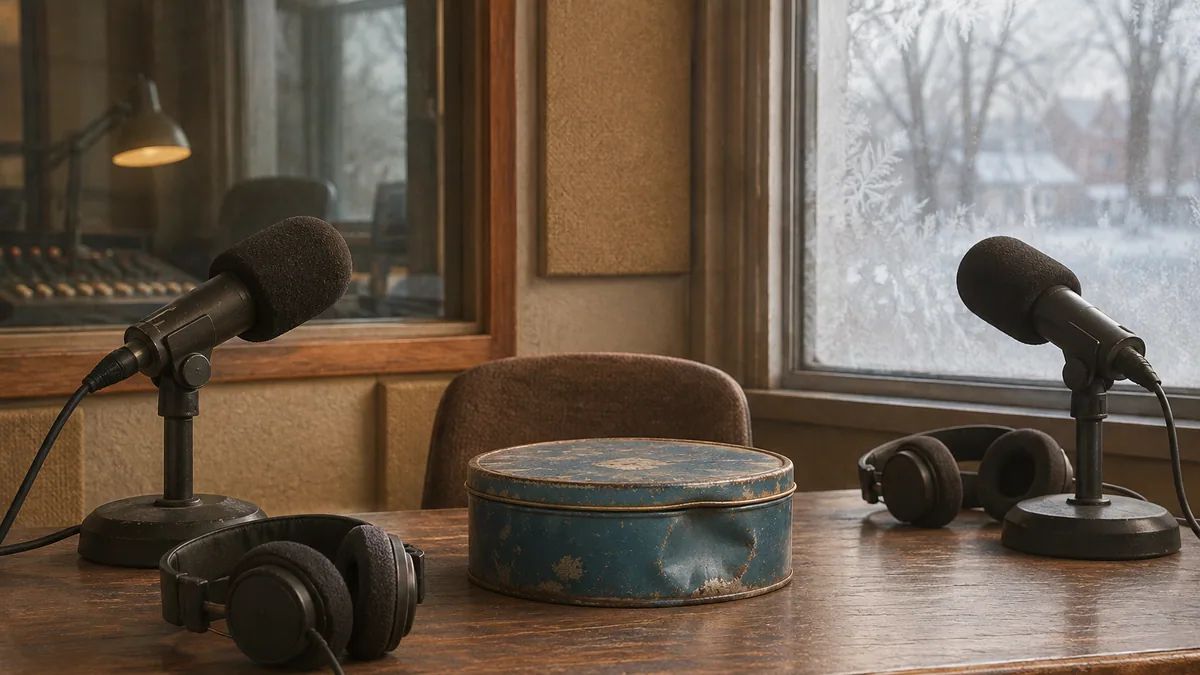
Twelve minutes before we went live, my guest asked whether the person he was about to name would be able to hear us from the parking lot.
“Depends whether the car radio works,” I said. “Who are you naming?”
He took a peppermint out of his coat pocket, thought about it, and put it back. “I’d better say it once.”
I was seventeen and had been producing the Saturday program at Fenwick Bend Community Radio for eight months. The station manager usually sat on the other side of the glass. That morning her water heater had given out, and she’d sent me a picture of three bath towels floating in her basement. She said she’d be listening from home.
My guest was Warren Pike. He’d spent forty years fixing the railroad crossing gates outside town, and he had the soft voice of somebody who expected a machine to make the louder noise. Today he’d brought a reel of tape in a dented blue tin. He’d set it on the desk with both hands, the way you set down a bowl filled to the rim.
We were supposed to talk about the old train depot one last time before the town turned it into a bus garage. The opening sound was going to be a recording of the brass station bell. We’d asked listeners to call in with memories. Our first caller had promised a story about a wedding cake that went to the wrong town.
My grandmother, Dottie, had driven me in because the station’s front steps were icy. She’d stayed to help with the phones. I could see her through the glass in her rust-colored coat, lining up three sharpened pencils on the counter. She lined up pencils when she was trying to hear something without looking as if she was listening.
Warren watched her for a while. “She made you wear boots?”
“She makes everyone wear boots.”
“She used to keep an extra pair in the depot.”
I knew the story about the depot, because everybody did. The river flooded the tracks thirty years ago. The last westbound train came to a stop and left again with one whole platform empty. A dozen people had been waiting in the rain and missed it. My grandmother was the attendant. For years people said she’d sent the engineer away early so she could close up.
“Ask me about that train,” Warren said.
I looked at the printed questions. We were going to talk about luggage carts, the conductor who could sew a button back on without taking off his jacket, and the bell. I put my finger on the last question, which was about where the bell had gone.
“We only booked you for ten minutes.”
“I only need one.”
I pulled my headphones down around my neck. On the other side of the glass Grandma lifted one of the pencils, then set it back in the row. We had agreed at breakfast that if anybody called about the flood, I’d let her decide whether to put them through.
Warren opened the tin. The tape inside was brown and loose at the end. He didn’t touch it. “Your manager made me a copy last week,” he said. “She thought it was just the bell.”
I found the file on the screen. It was nearly three minutes long. The bell sound we needed was only six seconds.
“What’s in the rest of it?” I asked.
Warren looked past me at the little red light above the studio door. “I’d like her to hear it the same time as everybody else.”
I turned around to see whether Grandma was still by the phones. Her chair was empty. When I looked back she was in the studio, pulling out the chair beside Warren. The wet cuffs of her coat left two marks on the desk. She took the spare headphones off their hook and waited for me to look up.
My grandmother put on the headphones and said, “If he’s going to tell that story, leave my microphone on.”
I had nine minutes. I slid Warren’s microphone down and put the recorder on playback through our headphones. “I can give you both the microphones,” I said. “I need to know what goes out over them.”
The bell struck twice. Somebody laughed close enough to the recorder to make the sound break up. Then I heard Warren’s voice, higher and faster than it was now.
“Dottie, you’ve got a bus?”
“Not yet,” said a woman I’d have recognized anywhere. “The driver’s still out on his route.”
There was a scraping sound. A door opened. Then Warren said, “I sent the train.”
Grandma took off one side of her headphones.
On the recording she asked him why. The younger Warren said a man on board had collapsed. The train could still make it to the crossing with a paved road where an ambulance could meet it. He’d seen the engineer looking up the platform for a signal, and he’d given him one. By the time he realized nobody had told Grandma, the red lights at the back of the train were gone.
The next voice on the tape wasn’t either of theirs. I could hear it only when I turned the sound up. “I don’t care where the train is,” a woman said. “I care where my mother is.”
Grandma stopped the playback. “That was Anita. Her mother lived across the river. Anita had been standing on the platform a long time before she asked me what happened.”
“Did you tell her?” I asked.
“I told her the train had gone and I was getting a bus. It was all she could do with the information right then.”
Through the glass the empty phone desk looked like a set nobody had finished building. Grandma had spent half the morning showing me how to put a caller at ease. Ask where they were calling from, she’d said, and give them time to name the road. Now I understood why she’d asked me at breakfast whether the woman from the station would be listening.
Warren turned his peppermint over in its wrapper. He said he’d expected to tell the rest once the water went down. But by then everyone knew a version that made sense to them. The passenger had recovered, and Warren had a plausible reason for wishing the whole thing would stay settled. Nobody had asked him why Dottie closed early. They asked why she hadn’t thought of them.
“I thought playing it would save you having to explain,” he said.
Grandma put her headphones back over both ears. “She was crying on that tape, Warren. You can tell your part without using hers.”
I took the recording out of the playlist and found the station bell on an older clip. We had four minutes. The cake caller rang early. I let it ring one more time while I asked Grandma what she wanted to say.
“I want to tell Anita I remember that she held the depot door so the bus driver could see where we were,” she said. “I never told her I noticed.”
When the light came on, I introduced the program and played the bell. There was a long enough silence after it that I could hear Warren unwrap the peppermint. He set it beside the blue tin and told the story in his own voice. He got the year wrong and Grandma corrected him. Then he said it was his hand that had gone up to send the train. He stopped there for a while. I kept the microphone where it was.
Grandma talked about the bus. It had been the one with the heater that worked in the front and not the back. People passed two spare coats down the aisle. At the shelter a man counted everyone twice because he’d started at the back the first time and couldn’t remember whether he’d counted himself. Then she thanked Anita for holding the door.
Our phone lit up. I thought it would be the wedding cake. Instead the caller said, “Tell Dottie those were my dad’s coats. He never got them back.” I asked whether she wanted me to put her on. She said yes, if she could tell the story about what her mother brought to the shelter in a pillowcase.
I had a typed introduction for the cake story, with the bakery and the wedding date and a joke I’d been practicing in the car. I folded it over. Through the glass I could see frost letting go of the lower corner of the window. Grandma slid one of her sharpened pencils over to Warren, and he wrote down the caller’s name.
We ran six minutes over.




Comments
Be the first to share your thoughts.