Pick a Paintbrush and See What It Says About You
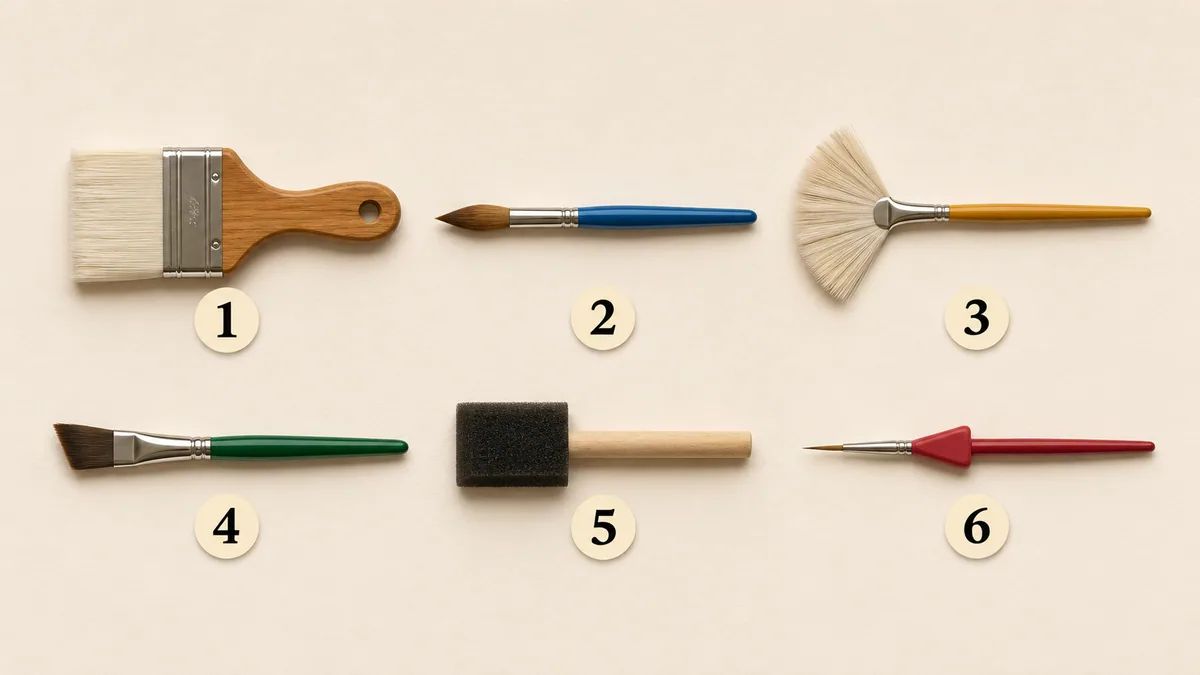
Six numbered paintbrushes are lying beside a blank sheet of paper. Pick the brush you’d reach for first, then see what your choice might say about you.
There’s no picture to copy and nobody has set a timer. The paper is clean and there’s more of it in the drawer. Imagine you can see all six brushes within reach, and give yourself one to start with.
1. The Wide Flat Brush
When you’re learning something new, you like to get a rough version in front of you quickly. If you’re trying to make bread, you’d rather mix the dough once and see what happens than spend the whole evening reading about it. Seeing the whole process, even once, gives you a sense of what the instructions are trying to describe. You’re good at getting past the stage when a new skill feels too large to touch.
You may decide you’ve learned a step before you’ve given it much attention. The loaf came out of the oven, so you move on, even though you’re still wondering why the middle was heavy. Try making the same loaf a second time and changing one thing. You’ll get more from a single repeat than you expected.
2. The Fine Round Brush
You learn through small, deliberate repetitions. When you’re trying a new stitch, you’re happy to do a whole row before worrying about what it’s going to become. You can feel when a motion gets easier, which gives you a reliable kind of encouragement. Your questions tend to get more exact with practice. By the time you ask somebody for help, you can often show them precisely where your hands stop knowing what to do.
You can put off using a skill until a practice piece looks as good as the thing you hoped to make. Pick a real object that can live with a bit of unevenness. A mended dish towel gets washed and used. In a month you may have to look quite hard to find the stitch that worried you.
3. The Fan Brush
You learn well by paying attention to the marks you didn’t mean to make. A brush drags across the paper, and you try the same thing again with less paint to see if that changes it. You’re good at noticing when the material has something to teach you. The odd little result somebody else brushes aside might be the thing you keep on the corner of the table for a week.
After an interesting accident, you can follow it so far that you forget what you sat down to learn. It helps to test one of your discoveries against a real question. Could that streak make the edge of a tree look softer? You’ll have more reason to remember the accident when you find it a place in a picture.
4. The Angled Brush
You learn by watching what somebody with more experience does at a difficult moment. You don’t need them to show you every fold in the paper. You want to see which way they turn it when two edges have to meet. You’re good at picking out the useful part of a demonstration and adapting it to your own hands. You can save yourself a great deal of frustration by asking to see one move again.
An expert’s way can look like the only possible angle when you’ve just watched it work. Once you’ve tried that move, give yourself a chance to turn the paper your own way. You may find a grip that feels better for you. That’s a fine thing to bring to the next lesson.
5. The Foam Brush
You learn best when the first attempt can be cheap and undignified. You’ll make a cardboard model to see if a shelf fits or test a drawing on the back of a used envelope. You’re good at lowering the cost of a mistake until curiosity can take over. There’s rarely a need to watch you for long before somebody else wants to have a go, too.
You may save the good supplies for a version you’ve postponed three times. At some point the practice material stops telling you what you need to know. Try the smallest real piece you can make. Even when it turns out strangely, you’ll learn how the actual wood, paper or cloth behaves in a way a substitute can’t show you. You can keep that first piece somewhere you’ll see it when you start the second.
6. The Pointed Detail Brush
You come to a new skill with a particular effect in mind. You might teach yourself one piano phrase because you want to hear the last three notes come out the way you remember them. A detail like that can give you the patience to look up a technique nobody would have talked you into learning for its own sake. You keep going because you know what you’re listening for.
It’s possible to spend so long on those three notes that your hands never learn how to get to them from the bar before. Work back a little and hear the phrase in its surroundings. You may find the sound you wanted was always going to depend on what you played just before it. Then you have a whole little phrase ready whenever you sit down to play.
Share your brush number and tell us what you’d try making with it first.
Just for fun. This quiz isn’t a psychological test.


Comments
Be the first to share your thoughts.