I Had One Stop to Ask Her a Different Question
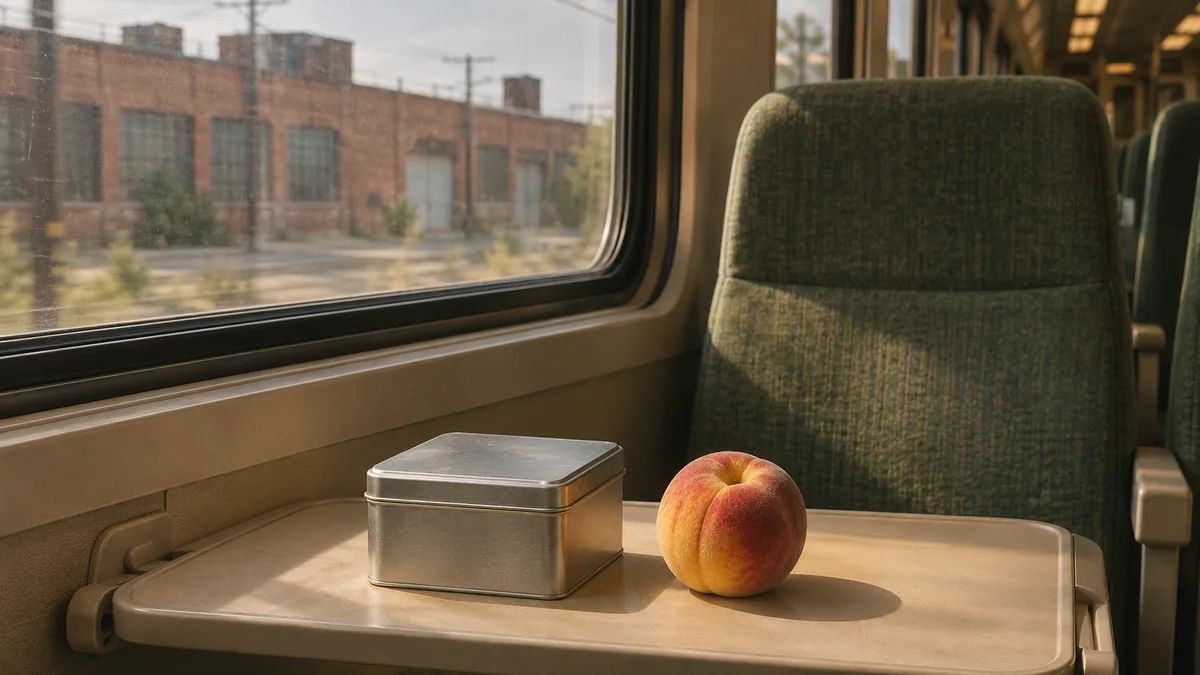
I got on at Rill Street with a speech in my pocket and no idea what to do with the peach.
The speech was on the back of a packing slip. The peach was because Ana always forgot to eat before a trip, then got halfway there and bought something that tasted like the cardboard it came in. I’d picked one hard enough to survive my coat pocket. By the time the train arrived, I was holding it in my hand like a ball I’d been waiting all morning to throw.
Ana had taken a job in Hartwell, three hours west. She was going out to sign for an apartment. I’d told her I couldn’t get away from the warehouse to ride with her. What I’d meant was that I wanted to stay home, where I could imagine her having a terrible time finding a place and coming back with a different plan.
At nine that morning I’d asked Leon to cover the dispatch desk for an hour. He took the pencil out from behind his ear and asked why I was still there.
“She doesn’t know I’m coming.”
“Are you doing something she’ll be glad you did?”
I said I was working on that part.
The commuter train was warm and smelled like damp sleeves. I walked through the first car and checked all the window seats because Ana liked to watch the loading docks disappear. I found her in the second car, wearing the blue coat she’d owned since before I knew her. A little square tin sat on the tray in front of her. She was trying to press the lid down with her thumb.
“Is that my sewing tin?” I asked.
“It was your cookie tin. I made it a sewing tin.”
“My cookies went in there first.”
“And now it’s got the screws for my bed frame. Do you want them loose in my bag?”
She moved her canvas tote out of the seat beside her. I sat down, put the peach on the tray, and watched it roll. Ana caught it against the tin without looking.
“I thought you were working,” she said.
“I got coverage. I have one stop.”
I’d take the train back from Mercer Junction. I knew exactly how long the ride was because I moved boxes through Mercer every day. Fourteen minutes if there was nothing waiting on the track. Long enough to say what I’d written and hear her answer, assuming the answer was one sentence.
She ran a finger over the peach. It had a bruise in the shape of the little corner of my phone. “You walked to the market for this?”
“I had time.”
“You always have time when there’s something you can carry.”
I reached for the packing slip. The first line said she could find work closer to home. I’d left out what kind, or whether anybody had offered it, or why a woman who’d spent six years drawing plans at our kitchen table should turn down the first job that paid her to draw them.
Outside, a row of empty freight cars passed. Ana leaned close to the window to catch the last of them. She used to draw in the mornings while I made coffee, one bare foot tucked behind the leg of her chair. I knew that picture so well I’d somehow confused it with a promise about what every morning would look like.
I folded the slip again. Ana heard the paper and opened her tote. “There’s something I was going to leave on the kitchen table,” she said.
She pulled out a flat cream envelope. The train went over a switch and the envelope slid under the tin. This time I was the one who caught it.
“I bought two tickets,” she said, “but I didn’t know if you’d want the other one.”
I looked inside. The tickets were for the following Saturday, one week after she’d move in. Both were round trips. She’d circled the return time on mine in blue pencil.
“Six forty,” I said.
“Six forty-two. I checked which train you’d still be able to make if your shift ran late.”
The copy of my schedule she had on her phone was three months old. I’d put it there myself when we were choosing a night to go out. Since then I’d changed all my Saturdays except that one.
“How long have you had these?”
“Since Tuesday,” she said. “You were fixing the loose handle on my suitcase. I almost gave them to you then, but you looked so happy to have found a screw that fit.”
I knew the look she meant. I’d laid all four screws out in order of length and kept the odd one in a saucer in case it turned out to belong somewhere. I’d spent twenty minutes on the handle and barely two on asking if she was scared.
“Are you?” I asked.
Ana tucked both hands into her coat pockets. “I’m scared I’ll get there and nobody will tell me which things I’m allowed to move. At work, I mean. I know how to draw a room. I want to see how they build one. But even at home I keep trying to picture where the kitchen table goes, and I don’t have one yet.”
“You want the little one by our window?”
“I want you to stop offering furniture for about a minute.”
I leaned back. Across the aisle a man was trying to fit a pastry bag into his coat without crushing it. He tried three pockets. The woman beside him finally opened her purse, and he handed the bag over.
“What was the thing you wanted to tell me?” Ana asked.
I gave her the packing slip. She read it all the way to the bottom, where I’d crossed out a sentence so heavily the paper had started to tear. I expected her to ask what that sentence said. She turned the paper over and looked at the other side.
“Forty-eight boxes of drawer pulls,” she read. “That’s a lot of drawers.”
“It was a hotel.”
“Were they good ones?”
“Little brass ones. Somebody counted them twice.”
She gave the slip back. Outside, the brick backs of Mercer’s warehouses had started showing through the trees. I’d used my fourteen minutes on a peach and a conversation about furniture. I still wanted to ask her to stay.
Instead I asked, “What do you want me to see when I come?”
Ana looked at me like she hadn’t heard the question right. I started to repeat it, but she put up one finger. She was thinking.
“There’s a round window in the stairwell,” she said. “I saw a picture of it in the listing and thought it was in the apartment. It isn’t. Everybody going up and down gets to look through it. I want you to see what’s out there.”
“What is out there?”
“I don’t know yet.”
I took my ticket out of the envelope and put it in the pocket that had held the peach. When we got to Mercer I stood up too early and had to sit back down while a freight train came through on the next track. Ana twisted the peach apart over the tin. It didn’t split cleanly. I got the half with the pit.
She said she could call me when she got there. I said I’d like that, and that if she was busy she could just send me a picture of the window. Then I asked whether she wanted me to bring anything next Saturday.
“Bring yourself hungry,” she said. “There’s a place across from the station that makes the bread right there.”
The doors opened. I took two steps onto the platform, turned back, and saw her lift the tin to catch the juice dripping from her wrist. She grinned. I put my hand up against the glass as the train pulled away.
A week later, we climbed the stairs together. Through the round window you could see a woman on the roof next door, taking sheets off a clothesline that ran between two chimneys. Ana made room for me on the step.
We stood there until the last sheet came down.
Comments
Be the first to share your thoughts.