My Brother Put Our Kitchen Table in the Auction
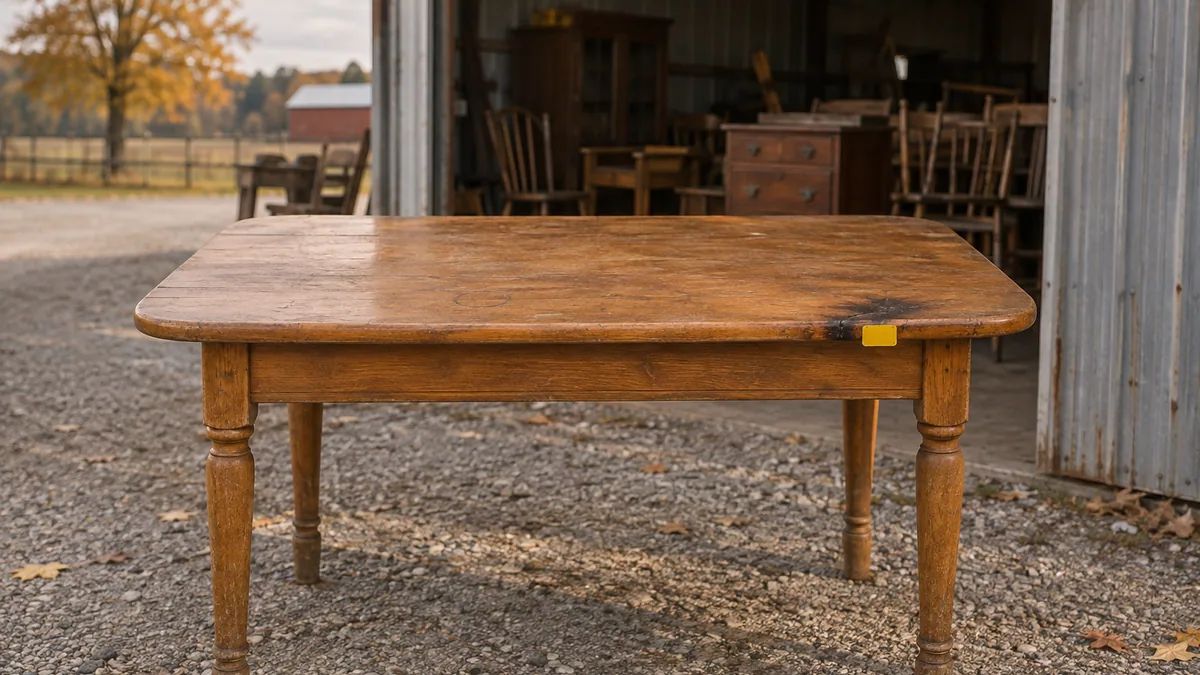
My brother had put a yellow auction sticker on the kitchen table, right over the burn mark shaped like Ohio.
“Could’ve picked a different spot,” I said. Cal leaned over to look. “It kept peeling up everywhere else.”
That burn was mine. At sixteen I’d set down a skillet after making my first grilled cheese. Dad had looked at the table, looked at my sandwich, and said, “Well, one of them’s done.”
I’d been driving a school bus for twenty-two years. I knew how to keep my face still while somebody in the back did something they couldn’t take back. I used that face on Cal.
Dad had moved into an apartment in town in September. The people buying the farm wanted the buildings empty by Monday. We’d agreed to sell the equipment and whatever furniture nobody had claimed. Cal had asked about the table twice. Both times I’d said I’d get back to him.
Outside the machine shed, a man in a seed cap ran a thumbnail along the table’s edge. He asked whether the top was solid oak. I said yes before remembering I could just let him walk away.
“You could’ve told me today was the day,” I said to Cal.
“I sent you the flyer.”
“You send me a lot of things.”
He shoved his hands into his brown canvas jacket. He’d sent pictures of Dad’s new apartment, too. In one, Dad was eating toast over the sink. I’d answered with a thumbs-up from the bus yard and called him nine days later.
I asked the clerk how much a table like that might bring. She said it depended on whether two people wanted it. I had sixty-three dollars in my purse, and I didn’t know whether the auction took cards.
Across the gravel, my niece Emma was coming from the parking field with a paper sack held against her chest. She was supposed to be at work. When she caught my eye, she stopped and looked at Cal, who shook his head just a little.
The auctioneer asked for an opening bid, and my brother raised his own paddle.
“Ten,” Cal said.
The man in the seed cap went to twenty. I held my hand halfway up, wondering if that counted, and Dad, sitting beside me in a folding chair, reached over and pulled gently on the cuff of my green coat.
“Let him,” he said.
At forty dollars the man put his paddle down. The auctioneer called it for forty, and Cal raised his paddle again before he realized he’d won. The auctioneer told him he’d make a fine customer if he could learn to stand still.
Cal went over to Dad and straightened the folding chair so he could see the table without turning his head. Dad rested both hands on his cane. Through the shed door, behind them, I could see the workbench he’d already watched go for thirty dollars.
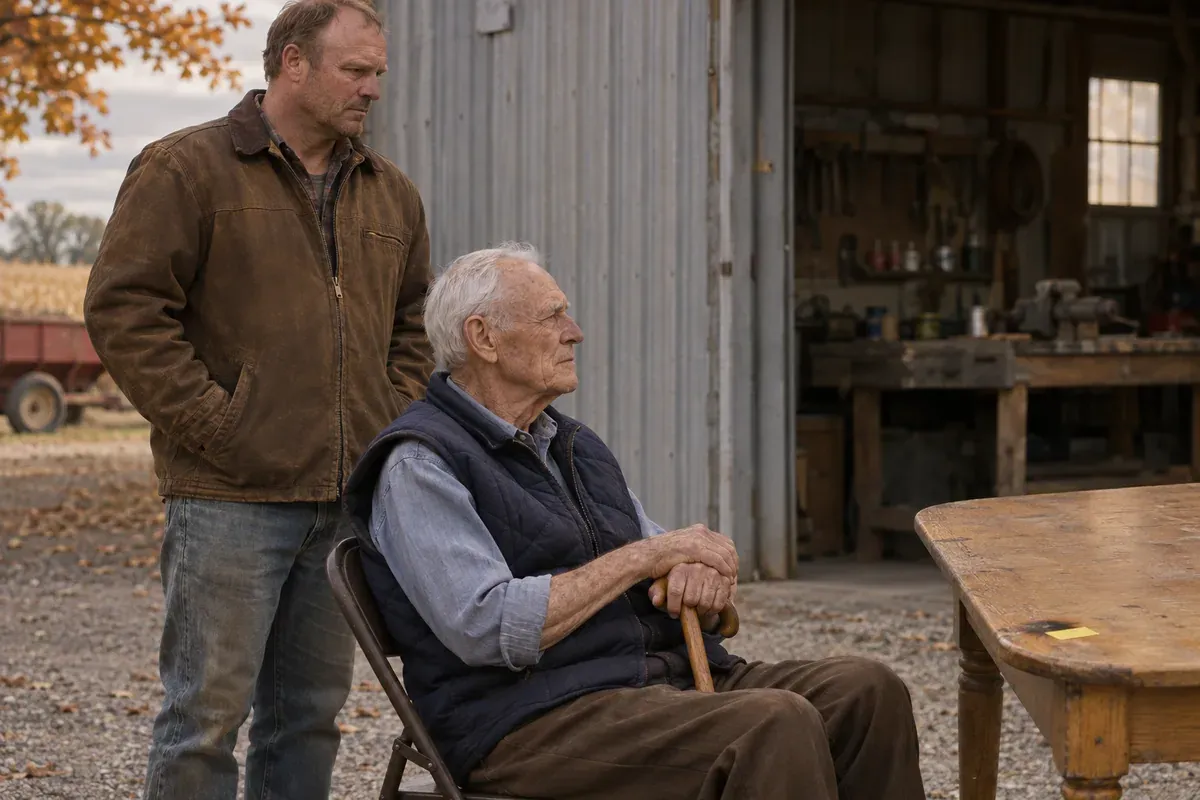
Emma set her paper sack on the table and began pulling out wax-paper bundles. I knew the shape of the sandwiches before I could smell the fried onions. Dad always made them with leftover pot roast, which meant making a pot roast first.
“Where’d you get those?”
“Grandpa’s,” she said. “I’ve been going over Sundays.”
Dad picked a bit of gravel out of the sole of his shoe with the tip of his cane. “Her and Cal. Three weeks now.”
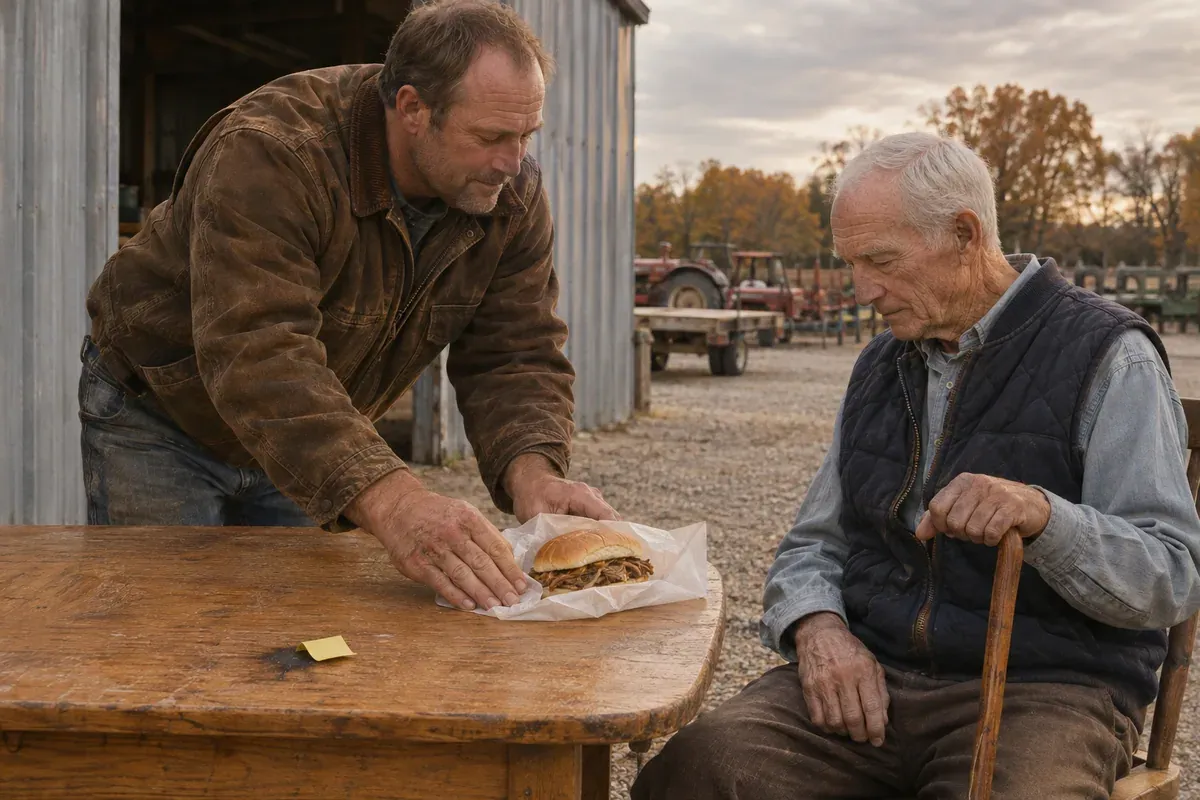
Cal smoothed the wax paper flat with both palms and pushed a sandwich toward Dad. The yellow sticker curled up between them, showing half of Ohio.
I’d been picturing Dad in that apartment alone. I’d been using the picture to feel bad and then getting busy enough to stop looking at it. When I finally called, I usually asked whether he needed anything from the store. He usually said no.
“Where are you taking the table?” I asked Cal.
“My garage, I guess. I measured Dad’s kitchen and there’s no way.”
“Show her the picture,” Emma said. Cal pulled up a photo of his garage. Where his fishing boat used to sit, there was a bare patch of concrete and an old rug with its corners taped down. Against the wall were four chairs from Dad’s kitchen, the ones Cal had said he was hauling away. He’d put a cushion on the one with the short leg.
“I sold the boat in August,” he said. “You can come through the side door. It’s the one without the step.”
It took me a moment to understand he meant Dad could come through it. Then it took me another to understand he meant me, too.
“I could do Sundays,” I said. “Every other one for sure. The other ones I’d have to tell you by Friday.”
“Friday’s plenty,” Cal said.
Emma asked who wanted the sandwich with the extra onions. Three of us answered, and she cut it into thirds with a plastic knife. We ate standing except for Dad, who wanted his chair pulled a little closer.
When we were done, Cal and I each took an end of the table. It was heavier than I remembered. We made it halfway to his truck before I had to set my end down.
Dad called across the gravel, “You got time.”
So I stood there a minute with my brother.
Comments
Be the first to share your thoughts.